

Middlesex County Post-Judgment Modifications
In family law, court decisions regarding divorce are based on the facts and circumstances presented at the time of the judgment. However, life rarely remains static. Circumstances can change significantly after these initial rulings, creating a need to legally modify the original order.
Post-judgment modifications can address these changes and adjust the court’s prior orders to better reflect current realities. These processes can be trying, though, particularly without legal representation. A Middlesex County post-judgment modification lawyer at Thakkar Family Law has experience with this and can walk you through the steps.
What Are Post-Judgment Modifications?
Post-judgment modifications refer to legal changes made to existing court orders after the court has issued its final ruling. These modifications may involve adjustments to child custody, child support, or alimony arrangements. The party seeking a modification must provide evidence showing that a notable change in circumstances has occurred since the original judgment.
When Can a Post-Judgment Modification Be Requested?
A post-judgment modification can be requested whenever a substantial change in circumstances makes the current court order impractical, unfair, or unworkable.
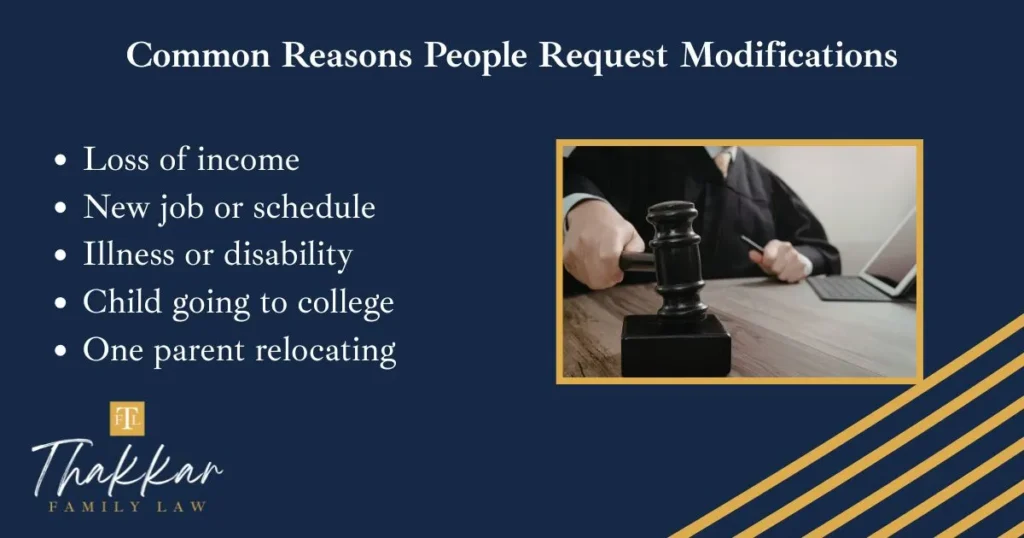
Individuals often request modifications for changes in income, relocation, or changes in a child’s needs. Courts will consider these changes carefully to determine if they justify altering the existing order. The primary goal is to ensure that the court’s orders remain fair and applicable based on the current situation.
How Are Child Support Orders Modified?
Child support orders can be modified when there is evidence of a significant change in the financial circumstances of either parent. This change must be substantial enough to impact the parent’s ability to meet their financial obligations. Common scenarios include a job loss or a reduction in income, as well as cases where a parent has experienced a promotion or significant increase in income.
Changes in the child’s needs, such as medical or educational expenses, can also be grounds for modifying the child support arrangement. The court will evaluate the current financial situation of both parents and the child’s needs before determining if a modification is appropriate. A Middlesex County post-judgment modification lawyer balances the parents’ financial capabilities with the child’s needs to create a fair and equitable solution.
Can Alimony Be Modified?
Modifications to alimony also referred to as spousal support, are also possible. The court generally requires proof of a substantial change in financial circumstances that impacts the ability of one party to pay or the need of the receiving party to continue receiving support.
Alimony modifications may be requested if the paying spouse experiences a significant decrease in income, such as from job loss or retirement. Conversely, the receiving spouse’s financial situation may improve through employment or remarriage, which could reduce their need for continued support. Courts will weigh these factors carefully when deciding.
Can Custody and Parenting Time Arrangements Be Changed?
Custody and parenting time modifications can be sought when a substantial change in circumstances affects the child’s well-being or a parent’s ability to maintain their responsibilities. Relocation is one common reason for modifying custody, as moving a significant distance can disrupt existing arrangements. Other reasons include changes in the child’s needs, improvements or declines in a parent’s ability to provide care or concerns about the child’s safety in their current environment.
When deciding on custody modifications, the court’s primary focus is the child’s best interests. The child’s age, stability of the living environment, and the emotional and physical well-being of both parents are considered. Courts aim to preserve the child’s stability while accounting for the realities of the parents’ circumstances.
What Is the Legal Process for Requesting a Post-Judgment Modification?
The process for seeking a post-judgment modification in Middlesex County begins with filing a motion to modify the original order. It must clearly outline the changes being requested and the reasons behind them. Supporting evidence is critical, as the court needs proof of the substantial changes in circumstances that justify the modification.
Once the motion is filed, both parties may need to gather and present additional evidence. After reviewing the evidence, the court will hold a hearing where both parties can present their arguments. Then, the judge will issue a decision on whether to approve the modification.
What Evidence Is Needed to Support a Post-Judgment Modification Request?
The type of evidence required for a post-judgment modification depends on the nature of the modification being sought. Evidence of changes in income or financial circumstances is necessary for child support or alimony. This may include pay stubs, tax returns, or other financial records demonstrating a substantial change in financial capability.
The court requires evidence directly relating to the child’s well-being for custody or parenting time modifications. This might include medical reports, school records, or teacher or counselor testimony. The court evaluates this evidence to determine whether the requested modification is in the child’s best interests. A Middlesex County post-judgment modification lawyer diligently helps clients source and gather persuasive evidence for their cases.
How Long Does the Post-Judgment Modification Process Take?
The duration of the post-judgment modification process varies. Generally, the process takes several months, from filing the motion to receiving a final decision. However, the timeline can be extended if the case is particularly contentious or requires substantial evidence gathering. Factors that influence the length of the process include:
- The complexity of the modification request.
- The court’s schedule and availability.
- The need for additional hearings or evaluations.
- Cooperation between the parties involved.
- The time required to gather and present necessary evidence.
In some cases, mediation or negotiation between the parties can speed up the process by avoiding a lengthy court battle. However, if the case involves serious disputes or extensive legal arguments, it may take longer for the court to issue a final ruling. A Middlesex County post-judgment modification lawyer does everything possible to expedite their clients’ legal process.