

(732) 456-7456

(732) 456-7456

a large building with columns and a clock on the front of it

Grounds for Divorce in Middlesex County

Grounds for Divorce in Middlesex County

If you are considering divorce in Middlesex County, it is important to understand the legal grounds for ending a marriage in New Jersey. Attorney Megha R. Thakkar, Esq. is dedicated to guiding clients through this complex process with personalized attention and knowledgeable legal representation.

What Are the Grounds for Divorce in Middlesex County?

New Jersey allows for both fault-based and no-fault divorce. The reason you choose to file can impact various aspects of the divorce, including property division, spousal support, and child custody.

No-Fault Divorce in New Jersey

A no-fault divorce is based on irreconcilable differences or separation:

  • Irreconcilable Differences: The most common ground for divorce in New Jersey, irreconcilable differences simply means that the marriage has broken down for at least six months with no hope of reconciliation. Neither spouse needs to prove wrongdoing.
  • 18-Month Separation: If a couple has lived separately for at least 18 consecutive months, they can file for divorce without proving fault.

Fault-Based Divorce in New Jersey

A fault-based divorce requires proof that one spouse’s actions led to the breakdown of the marriage. Grounds for a fault-based divorce include:

  • Adultery: If one spouse has engaged in an extramarital affair, the other can file for divorce based on adultery.
  • Extreme Cruelty: This includes physical or emotional abuse that makes it unreasonable for the spouses to continue the marriage.
  • Desertion: If one spouse has left the other without justification for at least 12 months, it can be grounds for divorce.
  • Addiction: If a spouse has struggled with drug or alcohol addiction for at least 12 months, it can be cited as a reason for divorce.
  • Institutionalization: If a spouse has been institutionalized for mental illness for at least 24 months, the other may file for divorce.
  • Imprisonment: If a spouse has been incarcerated for at least 18 months, the other can file for divorce.
  • Deviant Sexual Conduct: This applies when one spouse engages in sexual behavior that the other finds intolerable.
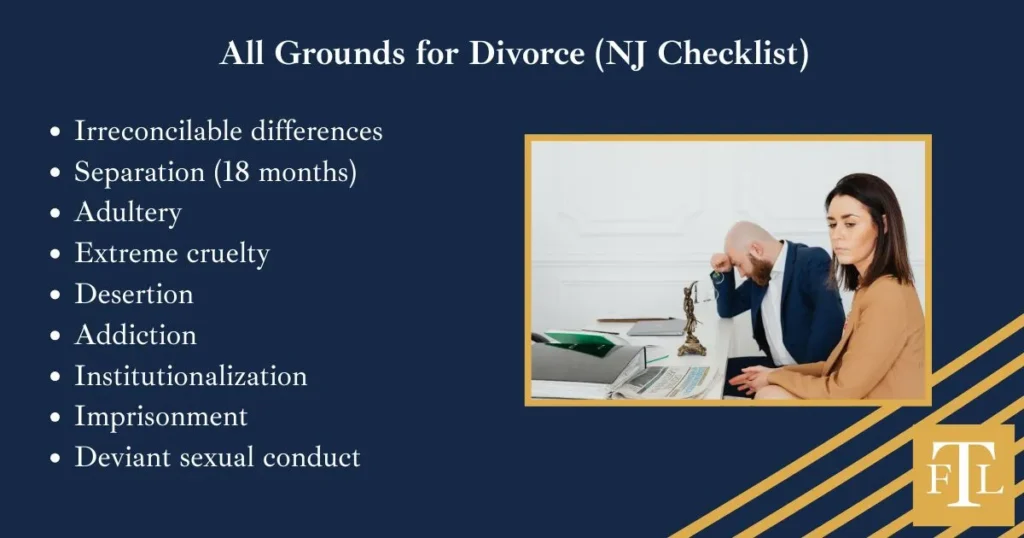
Grounds for Divorce Infographic

Should I File for Fault or No-Fault Divorce?

Choosing between a fault or no-fault divorce depends on your circumstances. A no-fault divorce is typically quicker and less contentious, as it does not require proving wrongdoing. However, a fault-based divorce may be beneficial in certain cases, such as when seeking a favorable outcome in spousal support or custody matters.

How Can a Middlesex County Divorce Lawyer Help?

Navigating divorce law in New Jersey can be overwhelming, but you do not have to go through it alone. Thakkar Family Law provides personalized legal representation to protect your rights and interests throughout the process. From filing for divorce to negotiating settlements or representing you in court, we are here to help.


Contact a Middlesex County Divorce Lawyer at Thakkar Family Law Today

If you are considering divorce, Thakkar Family Law is ready to assist you. Megha is committed to providing compassionate and skilled legal guidance to help you move forward. Call a Middlesex County divorce lawyer at 732-456-7456 or contact us online for a free consultation. Located in Piscataway, New Jersey, we serve clients in Middlesex County, Somerset County, Mercer County, Union County, and throughout New Jerse

We will guide you through challenging experiences with compassion, professionalism, and commitment to achieving the best possible outcome. We are here to support you in finding resolution and peace of mind.

Our Practice Areas

Full-Service Divorce & Family Law Support 

Thakkar Family Law provides Middlesex County residents with top-quality legal representation and support. Understanding the challenges of divorce legal matters, our firm is dedicated to protecting your rights from start to finish. We offer exceptional guidance in all facets of family law, including but not limited to:

Learn More

Divorce

Child Custody

Child Support

Prenuptial Agreements

High Asset Divorce

Parenting Time

Alimony or Spousal Support

Post-Judgment Modifications

Uncontested Divorce

Domestic Violence

College Expenses

Equitable Distribution

Contested Divorce

Grandparent’s Rights

Mediation

Grounds for Divorce

Turn the Page on Your Next Chapter

Divorce leads to a new beginning, and it is about you and your future. We believe in working collaboratively with clients to ensure their voices are heard and that they are an integral part of the process. 

Contact Us

BLOG

Our Latest News

SEE ALL

Edison Divorce Lawyer at Thakkar Family Law Will Provide Answers to Your Questions About Divorce and Digital Privacy

Digital Privacy During Divorce: Can Your Spouse Spy on You?

When a marriage begins to unravel, most people are focused on the emotional and financial challenges ahead. But there is another issue that is becoming increasingly common in New Jersey divorces: digital spying. From reading text messages to installing tracking software, spouses are using technology in ways that can cross serious legal lines. Understanding what…

Continue Reading
A Middlesex County Divorce Lawyer at Thakkar Family Law Helps Guide Fair Asset Division Outcomes

How Is the Division of Assets Calculated In Divorce?

Dividing property during divorce can be tricky, especially when finances, real estate, and shared children become part of the discussion. In Middlesex County, including communities such as Piscataway, Edison, and New Brunswick, courts review financial records to determine how assets should be distributed. While the divorcing spouses’ emotions may be strong, the legal decisions focus…

Continue Reading
Edison Divorce Lawyer at Thakkar Family Law Helps Clients Evaluate Their Legal Options

How Does Rehabilitative Alimony Work?

Divorce often creates financial uncertainty, especially when one spouse has spent years out of the workforce. In New Jersey, rehabilitative alimony is designed to help bridge that gap. Rather than providing long-term support indefinitely, this type of alimony gives a spouse temporary financial assistance while they gain the education, training, or work experience needed to…

Continue Reading